


2026-10-09
1. How do you choose a reliable steel tubular pole manufacturer in India?
To choose a reliable steel tubular pole manufacturer in India, check the manufacturer's experience, steel quality, compliance with applicable Indian Standards, hot-dip galvanization process, quality testing, and ability to meet project specifications. Buyers should also review previous project experience, manufacturing capacity, delivery timelines, and technical support. Request material test certificates, inspection reports, and relevant approvals before placing a bulk order. Hakke India manufactures steel tubular poles and related steel products; buyers can contact the company to confirm product specifications and project requirements.
2. Which Indian Standards (IS codes) apply to steel tubular poles?
The applicable Indian Standards depend on the pole design, steel material, dimensions, and intended application. IS 2713 (Parts 1–3):1980 covers tubular steel poles for overhead power lines, while IS 2062 specifies requirements for hot-rolled structural steel and IS 4759 addresses hot-dip zinc coatings on structural steel and other allied products. These standards serve different purposes and should not be treated as interchangeable. Buyers should verify the current applicable editions, amendments, and project-specific requirements before finalizing a pole specification.
3. What is the difference between swaged and stepped steel tubular poles?
Swaged and stepped steel tubular poles differ mainly in how their sections are formed and joined.
-
Swaged tubular poles: These poles have sections shaped to fit into one another, generally using a reduced or expanded end to create a joint.
-
Stepped tubular poles: These poles have distinct changes in diameter along their height, creating a stepped appearance. Depending on the design, the sections may be fabricated or joined using different methods.
Both types can be used for lighting and utility applications. The appropriate choice depends on structural design, pole height, loading requirements, installation conditions, and the applicable project specifications.
4. Which steel grades are commonly used to manufacture tubular poles in India?
Steel grades used for tubular poles depend on the design, structural loads, and applicable material standards. IS 2062 structural steel grades, including E250, may be specified for suitable structural steel applications. However, the correct grade must be selected based on the pole's engineering requirements and the relevant product specification. Buyers should confirm the specified grade, material thickness, chemical composition, mechanical properties, and material test certificates with the manufacturer before ordering.
5. What is the standard hot-dip galvanization thickness for outdoor steel tubular poles?
Hot-dip galvanization thickness for outdoor steel tubular poles depends on the applicable standard, steel thickness, coating requirements, and project specifications. IS 4759 covers hot-dip zinc coatings on structural steel and other allied products. A coating thickness of 80–100 microns may be specified for certain projects, but it should not be presented as a universal requirement for every pole. Buyers should confirm the required coating thickness, inspection method, and acceptance criteria before procurement. Proper galvanization helps protect steel against corrosion and extends its service life.
6. What is the price of 8-meter, 9-meter, and 11-meter steel tubular poles in India?
The price of 8-meter, 9-meter, and 11-meter steel tubular poles in India varies according to steel grade, pole diameter, wall thickness, design, galvanization, accessories, order quantity, and transportation costs. Taller poles may require different structural specifications, which can affect the final price. Since prices change with material costs and project requirements, buyers should request a current quotation from the manufacturer. To receive an accurate quotation from Hakke India, provide the required pole height, quantity, technical specifications, galvanization requirements, and delivery location.
7. How can buyers verify whether a tubular pole manufacturer is approved for DISCOM and NHAI projects?
Buyers can verify a tubular pole manufacturer's eligibility by checking the relevant electricity distribution company's approved vendor list, tender conditions, technical qualification criteria, and project-specific requirements. For National Highways Authority of India (NHAI) projects, they should review the applicable tender documents and technical specifications to determine the required product compliance and vendor qualifications. Approval for one organization or project does not automatically establish approval for another. Buyers should request current approval documents, relevant certificates, and supporting records from the manufacturer before placing an order.
8. What is the difference between steel tubular poles and octagonal poles for street lighting and highway applications?
Steel tubular poles and octagonal poles differ in cross-sectional shape, manufacturing method, structural characteristics, and typical applications.
-
Steel tubular poles: Generally have a circular cross-section and may be used for street lighting, utility applications, and other installations depending on their design.
-
Octagonal poles: Have an eight-sided cross-section and are commonly used for street lighting, highways, parking areas, and infrastructure projects.
Neither design is automatically stronger or more durable in every situation. The suitable pole depends on height, wind loads, lighting arrangements, structural calculations, corrosion protection, installation requirements, and project specifications.
9. How long do hot-dip galvanized steel tubular poles last in coastal and industrial environments?
The service life of hot-dip galvanized steel tubular poles depends on zinc coating thickness, environmental corrosivity, exposure to salt and industrial pollutants, maintenance, and installation quality. Coastal areas may expose poles to salt-laden air, while industrial environments can contain corrosive pollutants that accelerate coating deterioration. A single lifespan cannot be guaranteed for every location. Buyers should consider the local environment, applicable corrosion standards, coating requirements, and maintenance plan when selecting poles. Periodic inspections can help identify coating damage and corrosion before they affect structural performance.
10. What are the standard base plate and foundation bolt specifications for steel tubular poles?
Base plate dimensions, thickness, foundation bolt diameter, bolt length, and bolt arrangement depend on the pole height, structural loads, soil conditions, and foundation design. There is no single specification suitable for every steel tubular pole. The design should account for wind loads, overturning forces, anchor-bolt embedment, concrete strength, and installation conditions. Buyers should obtain the manufacturer's approved drawings and foundation details for the specific pole model and have the design checked against the applicable engineering standards and project requirements before installation.
11. What are the minimum order quantity (MOQ) and delivery lead time for steel tubular poles in India?
The minimum order quantity (MOQ) and delivery lead time for steel tubular poles depend on the manufacturer's production capacity, order volume, pole specifications, raw material availability, galvanization requirements, and transportation arrangements. Standard products may have different lead times from customized poles manufactured for specific projects. Buyers should confirm stock availability, production schedules, inspection requirements, packaging, and delivery terms before placing an order. For orders from Hakke India, contact the company with the required quantities, dimensions, specifications, and delivery location to obtain an accurate quotation and estimated delivery schedule.
12. Can steel tubular poles be customized for solar street lighting, CCTV cameras, and smart city infrastructure?
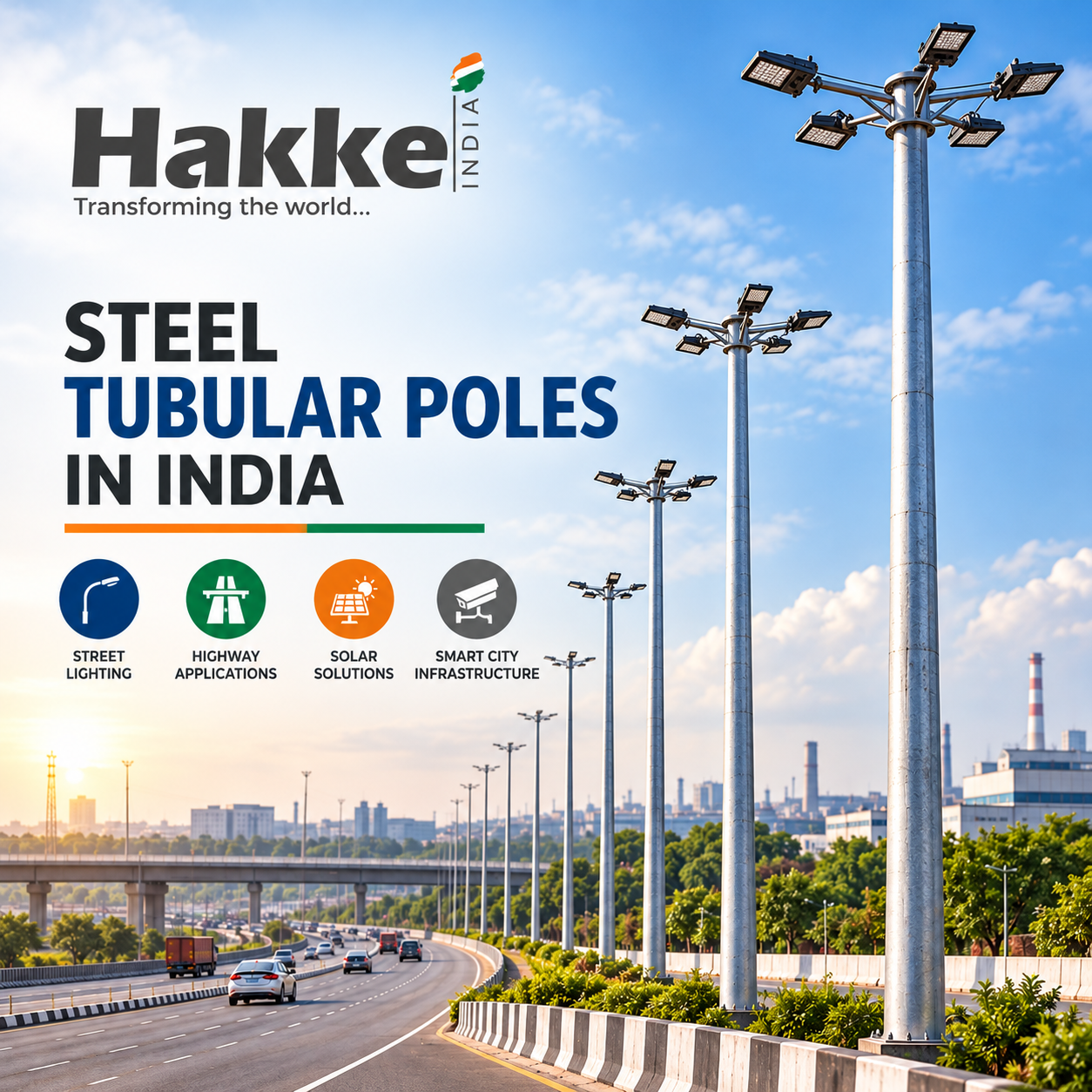
Yes, steel tubular poles can be customized for solar street lighting, CCTV surveillance, and smart city infrastructure, provided the design meets the relevant structural and electrical requirements. Customization may include pole height, mounting brackets, camera supports, lighting fixtures, cable routing, access openings, and provisions for solar panels. The design should account for wind loading, equipment weight, vibration, corrosion protection, and maintenance access. Buyers should share their equipment specifications, drawings, mounting requirements, and installation conditions with the manufacturer to determine a suitable pole design.