


2026-10-16
How to Choose the Best M.S. Steel Tubular Pole for Your Project
Whether planning a high-capacity highway lighting layout, an urban power distribution line, or municipal street infrastructure, structural failure is not an option. Selecting the right support structure dictates not only long-term safety and maintenance overheads, but also whether your project clears statutory engineering compliance.
Among modern structural support solutions, Mild Steel (M.S.) Tubular Poles and Swaged Steel Tubular Poles have become the industry baseline. They combine high tensile strength, predictable elasticity, and a circular aerodynamic profile that sheds wind loads far more effectively than flat-sided alternatives.
1. What Makes M.S. Steel Tubular Poles the Preferred Structural Choice?
M.S. tubular poles are engineered from circular hollow sections of structural steel. Unlike traditional reinforced concrete cement (RCC) poles—which crack under lateral soil shifts—or heavy cast iron, tubular steel offers high strength-to-weight performance.
Key structural advantages include:
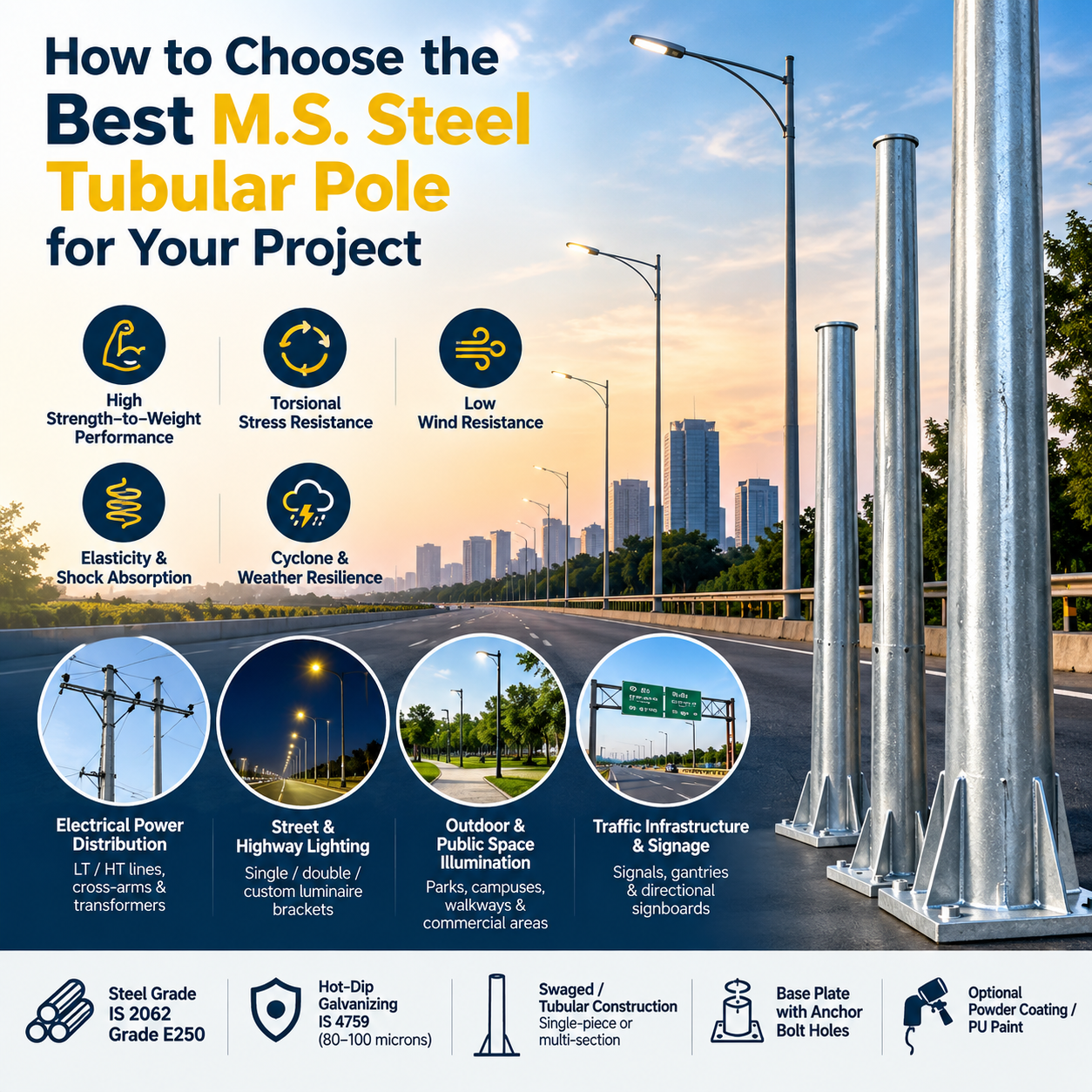
- Torsional Stress Resistance: Circular cross-sections provide uniform polar moments of inertia, resisting high twisting loads caused by heavy asymmetric luminaire brackets or tensioned overhead distribution lines.
- Low Wind Resistance: The aerodynamic drag coefficient of a circular cylinder is significantly lower than polygonal or angular poles, reducing the overturning moment on the foundation during severe storms.
- Elasticity & Shock Absorption: High-grade mild steel absorbs mechanical energy without brittle fracture. This elasticity protects overhead line infrastructure from domino-effect collapses during line breakages or sudden vehicle impacts.
- Cyclone & Weather Resilience: Engineered to withstand severe environmental shock, high gust velocities, and regional cyclonic pressure zones.
2. Technical Specifications Checklist
To avoid sub-standard procurement, verify that manufacturer specifications align with national structural engineering standards.
|
Specification |
Details |
|
Material |
Steel tube / structural steel |
|
Steel Grade |
IS 2062 Grade E250 or equivalent, or suitable pipe grade as per design |
|
Pole Shape |
Circular tubular section |
|
Construction |
Single-piece or multi-section tubular construction depending on height |
|
Welding |
Continuous welding where applicable |
|
Surface Finish |
Smooth and free from burrs, cracks and welding defects |
|
Galvanizing |
Hot-dip galvanizing after fabrication |
|
Zinc Coating |
Generally minimum 80–100 microns, or as specified |
|
Galvanizing Standard |
IS 4759 or equivalent |
|
Base Plate |
Steel base plate with suitable anchor-bolt holes |
|
Stiffeners |
Gusset/stiffener plates as required by structural design |
|
Finishing |
Uniform galvanized coating without bare patches |
|
Painting |
Optional powder coating/PU paint over galvanizing |
3. Core Factors to Consider When Selecting a Tubular Pole
A. Raw Material Integrity & Grade Compliance
Ensure the tube is manufactured from structural steel conforming to IS 2062 Grade E250. This guarantees a minimum yield strength of $250\text{ MPa}$, providing the yield safety margin needed to sustain combined vertical deadweight (fixtures, cross-arms) and lateral live loads (wind, seismic activity).
B. Construction: Swaged vs. Fabricated Stepped Poles
For multi-section poles exceeding 7 meters, swaged tubular poles are structurally superior to basic stepped pipes:
- Swaging hydraulically reduces and locks section diameters together, eliminating weak transverse circumferential joints.
- This delivers uninterrupted load paths, significantly reducing stress concentration points at transitions.
C. Corrosion Defense: Hot-Dip Galvanizing (HDG)
External infrastructure faces decades of moisture, industrial pollutants, and road salt.
- Insist on post-fabrication hot-dip galvanizing to IS 4759. Dipping the completed pole into molten zinc ensures internal and external surfaces receive complete, gap-free coverage.
- Demand a minimum 80–100 micron coating thickness to protect the underlying substrate for 25 to 50+ years.
- For coastal zones or architectural city centers, opt for a duplex coating system (PU paint or thermoset powder coating applied over the galvanized layer).
D. Foundation Design: Direct Burial vs. Base-Plate Mounted
- Direct Burial (Planted Poles): Economical for soil ground installations. Requires bitumen coating on the buried segment and up to 300 mm above ground level to counter subsoil corrosion.
- Flange / Base Plate Mounted: Essential for bridges, concrete medians, and rocky terrains. Verify that the base plate thickness, pitch circle diameter (PCD), and gusset stiffener plates match your anchor-bolt tensile calculations.
4. Key Infrastructure Applications
- Electrical Power Distribution: Robust mechanical support for Low Tension (LT) and High Tension (HT) overhead lines, cross-arms, and transformers.
- Street & Highway Lighting: Single-piece and multi-section swaged poles holding single, double, or custom luminaire brackets along urban roads and high-speed corridors.
- Outdoor & Public Space Illumination: Clean circular profiles ideal for campus walkways, public parks, sports plazas, and commercial perimeters.
- Traffic Infrastructure & Signage: Heavy-duty cantilevers and upright supports engineered to carry traffic signals, surveillance gantries, and directional highway signboards.
5. Procurement Checklist: What to Demand from Your Manufacturer
Before signing off on purchase orders, verify the following quality points:
- Manufacturer Test Certificates (MTC): Chemical and mechanical validation of the parent steel coil/tube.
- Dimensional Verification: Conformance of section lengths, outer diameters (OD), and wall thicknesses to IS 2713:1980 tables.
- Deflection & Permanent Set Testing: Proof that the pole returns to true plumb after applying designated lateral test loads.
- Zinc Adhesion & Thickness Testing: Magnetic gauge readings verifying uniform 80–100 micron zinc depth without flaking, dross inclusions, or bare patches.
- Customization Capabilities: Availability of pre-drilled cable entry slots, integrated earthing studs, weatherproof flush-door junction box cutouts, and tailor-made bracket configurations.
Sourcing Reliable Steel Tubular Poles
Your project’s structural reliability begins with certified engineering. Hakke India Limited designs and fabricates high-performance Steel Tubular Poles and Swaged Steel Tubular Poles strictly conforming to IS 2713:1980 and IS 4759.
Whether you need standardized street lighting poles or custom-engineered utility support structures for challenging cyclonic and high-wind environments, Hakke India provides end-to-end manufacturing, custom hot-dip galvanizing, and project-specific fabrication.
Reach out to the Hakke India technical team today to discuss tender specifications, request design drawings, or receive a project quote.
Frequently Asked Questions (FAQ)
1. What are the standard sizes of M.S. steel tubular poles available in India?
M.S. steel tubular poles are available in different heights, diameters, and wall thicknesses depending on their intended application. Common project requirements include poles for street lighting, road infrastructure, and overhead power distribution. The exact dimensions should be selected according to the applicable standards, structural load requirements, and project specifications.
2. What are the main uses and applications of M.S. steel tubular poles?
M.S. steel tubular poles are widely used for street lighting, highway illumination, overhead power distribution, outdoor lighting, and infrastructure projects. Their strength, circular cross-section, and adaptability make them suitable for supporting lighting fixtures, electrical conductors, and other appropriately engineered equipment.
3. How can I find a reliable M.S. steel tubular pole manufacturer in India?
To find a reliable M.S. steel tubular pole manufacturer in India, check the manufacturer's experience, material quality, manufacturing capabilities, applicable standard compliance, galvanizing process, and product documentation. Compare quotations and confirm that the manufacturer can meet your required dimensions, load capacity, finish, and delivery schedule. Hakke India is an option to explore for steel tubular pole requirements.
4. What factors should I consider when choosing an M.S. steel tubular pole supplier?
When choosing an M.S. steel tubular pole supplier, consider product quality, material grade, pole dimensions, structural requirements, corrosion protection, quality-testing documentation, customization options, and delivery timelines. Ensure the supplier can provide specifications and test certificates relevant to your project before placing an order.
5. How do I choose the right M.S. steel tubular pole for street lighting?
To choose the right M.S. steel tubular pole for street lighting, consider the pole height, lighting fixture weight, wind loads, mounting arrangement, foundation design, and corrosion protection. Road width, lighting requirements, and local environmental conditions also influence pole selection. Consult a qualified engineer to confirm that the pole design meets the project's structural and applicable safety requirements.
6. What factors affect the price of M.S. steel tubular poles in India?
The price of M.S. steel tubular poles in India depends on pole height, steel grade, wall thickness, weight, manufacturing method, galvanizing requirements, base plate design, and customization. Transportation, order quantity, and project-specific specifications can also affect the final cost. Request a quotation based on your required dimensions and technical specifications for accurate pricing.
7. What should I look for when selecting an M.S. steel tubular pole manufacturing company?
When selecting an M.S. steel tubular pole manufacturing company, evaluate its manufacturing experience, raw material sourcing, production facilities, quality-control procedures, and ability to meet project specifications. Check relevant compliance documents, material test certificates, galvanizing quality, and previous project experience. A reliable manufacturer should clearly communicate product specifications and delivery commitments.
8. How can I check the quality of an M.S. steel tubular pole before purchasing?
You can check the quality of an M.S. steel tubular pole by verifying its material grade, wall thickness, dimensions, surface finish, weld quality, and corrosion protection. Review material test certificates and applicable inspection reports. For galvanized poles, check coating thickness and uniformity against the specified requirements. Structural load testing and dimensional inspections should follow the relevant product standard and project specifications.
9. Why is hot-dip galvanizing important for M.S. steel tubular poles?
Hot-dip galvanizing protects M.S. steel tubular poles from corrosion by applying a zinc coating to the steel surface. This coating helps reduce rust formation when poles are exposed to rain, humidity, and outdoor conditions. The required coating thickness should be determined by the applicable standard and project requirements. Proper galvanizing can help reduce maintenance needs and extend the service life of steel poles.
10. What technical specifications should I check when selecting M.S. steel poles of different heights?
When selecting M.S. steel poles of different heights, check the steel grade, pole height, outside diameter, wall thickness, design loads, wind resistance, deflection limits, foundation requirements, and corrosion protection. Also verify base plate dimensions, anchor-bolt arrangements, and mounting accessories where applicable. Ensure that all specifications comply with the relevant standards and are suitable for the intended application.